

Open enrollment is here, which means it’s time to pick a health insurance plan. Last year was hard. The enhanced tax credits on marketplace plans expired and a lot of us saw our premiums jump. This year, prices are going up again, and a couple of rule changes make self-employed health insurance in 2027 trickier than it used to be.
I just went through this for my own family, so here’s what changed, how I shopped, what the alternatives cost, and a few ways to bring the price down. The video walks through all of it, including a live look at my state’s marketplace.
Quick note: I’m not an insurance agent or a tax pro. I’m a self-employed guy who’s been through this a few times. Your health, your income, your family and your state are different from mine, so use this as a starting point.
What changed for 2027
The extra subsidies are gone, and the cliff is back
From 2021 through 2025, enhanced tax credits made marketplace plans cheaper for a lot more people. Before that, financial help ended the moment your income crossed 400% of the federal poverty line.
Here’s what that looked like. In 2020, a family of three making $85,300 could get help with their insurance. In one scenario I ran, it was about $5,000 for the year. A $200 Christmas bonus would have pushed them to $85,500, over the limit, and that $5,000 disappeared. That cliff kept me out of the marketplace back then, because as a freelancer I couldn’t predict my income that closely.
The enhanced credits replaced the cliff with a gradual taper. They expired at the end of 2025, and the cliff came back with them.
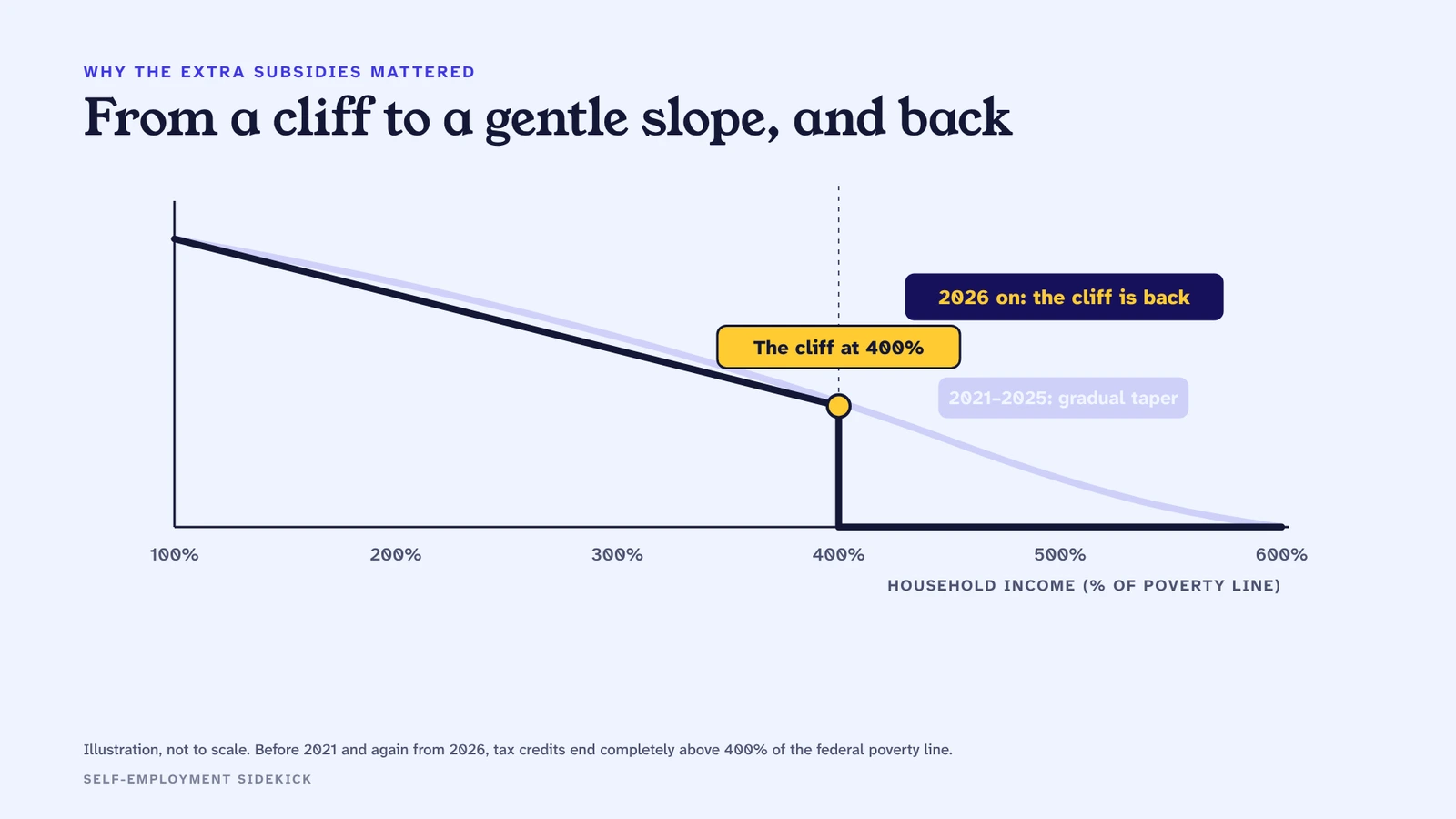
Congress has gone back and forth on bringing them back. As of November 2026, nothing has changed, so shop with the prices in front of you.
There’s no cap on paying it back
This is the one I think will catch a lot of freelancers off guard.
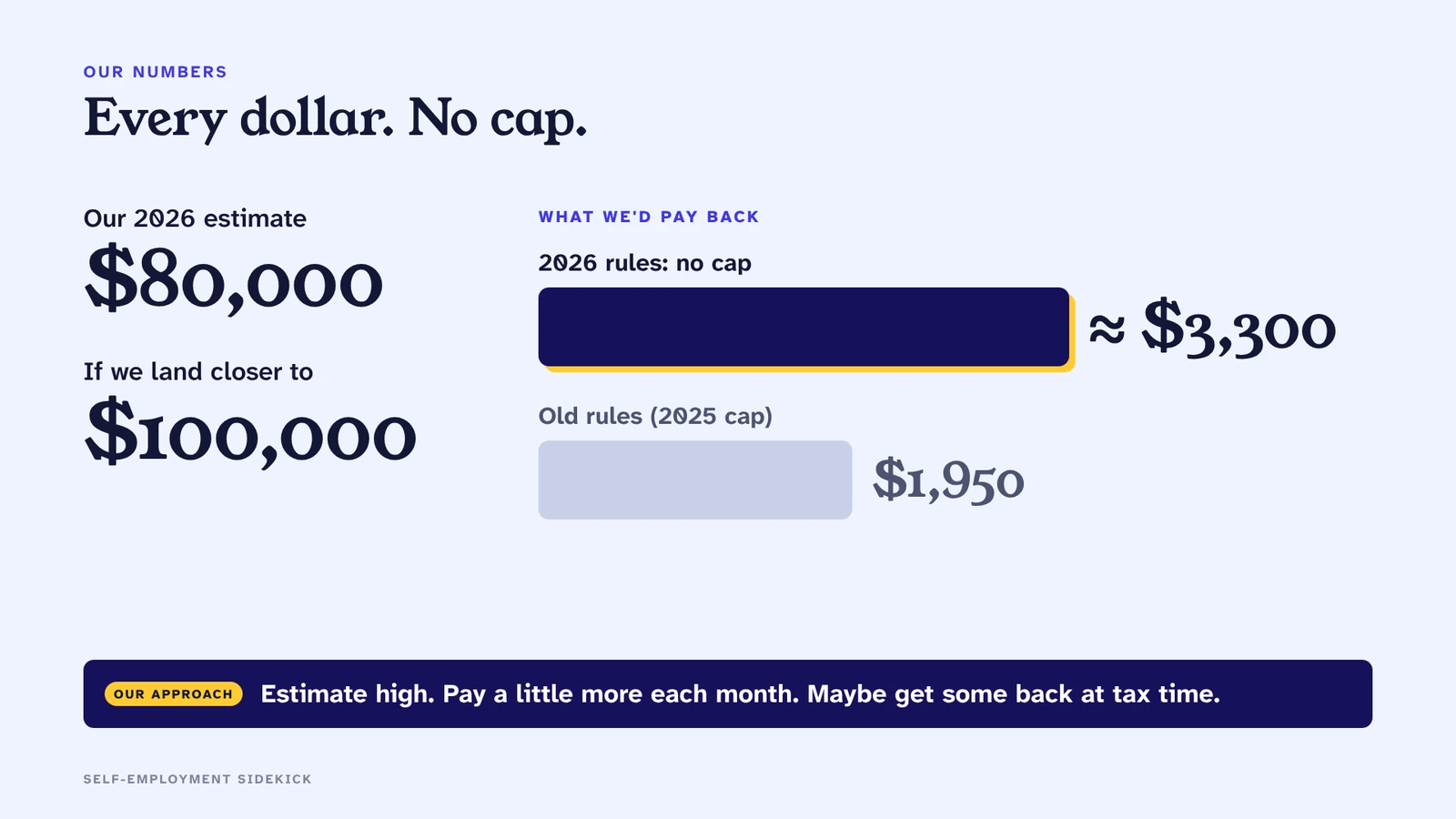
Your tax credit is based on what you think you’ll earn next year. If you guess low and then land a few extra projects, you were given more credit than you qualified for, and you owe the difference at tax time. There used to be a limit on how much you’d have to repay. The IRS says that starting with tax year 2026, you repay the full amount.
I might be one of the people who gets caught. I estimated $80,000 for 2026. If we end up closer to $100,000, that’s about $3,300 we’ll owe back. Under the old rule it would have stopped at $1,950.
Prices went up again
In Pennsylvania, individual plans are going up an average of 15.97% for 2027, according to the state Insurance Department. That’s on top of last year’s jump. Other states are seeing double-digit increases too.
A little good news
- All Bronze plans are now HSA-eligible. This started in 2026, and it matters a lot for keeping your costs down. More on that below.
- Catastrophic plans are open to more people. They used to be mostly for people under 30. Now, in most states, you can get one at any age through a hardship exemption if your income is under 100% or over 250% of the poverty line. The catch is that your tax credit can’t be used on one, and the deductible is very high. They mostly make sense if you get little or no tax credit.
- Direct primary care works with an HSA. More doctors are offering monthly memberships. Signing up for one used to disqualify you from contributing to an HSA. Now it doesn’t, as long as the membership is $150 a month or less ($300 for a family).
How to shop for a marketplace plan
Start with the marketplace, even if you end up somewhere else. It gives you a baseline to compare everything against.
Your cost depends on your premium tax credit, and your tax credit depends on two things: your household income and your household size.
Income means your adjusted gross income (AGI), the number on your tax return after certain deductions. It isn’t your take-home pay. Retirement and HSA contributions lower it, which is a big reason I like HSA-eligible plans. (The marketplace technically uses “modified” AGI. For most people it’s the same number.)
Household size is everyone on your tax return, including kids who get their insurance somewhere else. My three boys are on CHIP, but they still count, so we’re a household of five.
Together, those two numbers place you somewhere relative to the federal poverty line (FPL), and that decides what help you get.
| Household size | 138% of FPL | 250% of FPL | 400% of FPL |
|---|---|---|---|
| 1 | $22,025 | $39,900 | $63,840 |
| 2 | $29,863 | $54,100 | $86,560 |
| 3 | $37,702 | $68,300 | $109,280 |
| 4 | $45,540 | $82,500 | $132,000 |
| 5 | $53,378 | $96,700 | $154,720 |
Under 138%, you’re likely eligible for Medicaid in the states that expanded it, which is most of them. Between 138% and 250%, you get bigger tax credits and access to Silver plans with extra savings. Between 250% and 400%, you still get a credit on a sliding scale. Over 400%, you get nothing.
That’s a lot of math, so I built a free calculator to give you a ballpark: sidekick.show/health.
Then go to your state’s marketplace and fill out their questionnaire. If you don’t know what yours is, go to HealthCare.gov, pick your state, and it’ll send you to the right place. Mine is Pennie.
A few things I’d pass along from doing this myself:
- List your whole tax household, even people who don’t need coverage. I list my kids so they count toward our household size, then mark that only my wife and I need a plan.
- Pull out last year’s tax return to find your AGI, then adjust for what you expect next year.
- Try a few income numbers if you’re not sure what you’ll make. You’ll see how much your price moves.
I plugged in $90,000 for 2027. That got us a tax credit of about $440 a month, which brings our Bronze plan from $754 down to $314.
Don’t guess low on your income
It’s tempting to shave your income estimate to get a lower price. Don’t. I’d push it as high as you can reasonably expect.
If you guess high and come in under, you get the difference back when you file. If you guess low and come in over, you pay it back, and now there’s no cap. Unless you’re tracking your income closely and setting money aside, that bill can hurt.
I’d rather pay a slightly higher premium every month and maybe get some back at tax time than end up without enough in the bank to cover what I owe.
Bronze, Silver or Gold
The two numbers that matter most are the premium (what you pay every month) and the deductible (what you pay out of pocket before insurance chips in). Usually, the lower one is, the higher the other.
Bronze plans have the lowest premiums and the highest deductibles. Silver is in the middle. Gold costs more each month with a lower deductible. More expensive plans can make sense if you have ongoing, predictable, high-cost medical needs.
We’re going with Bronze again. It’s the cheapest, it’s HSA-eligible, and it covers basic preventive care. The risk is the $8,000 deductible per person. But that’s a maybe. A Silver plan for us runs about $600 a month. That’s a definite $3,400 or so more a year in premiums for the chance of paying a few thousand less in deductibles. I’m sticking with Bronze.
Whatever you lean toward, open the plan details. Check what it really costs, what it covers, and whether your doctors and prescriptions are in the network.
What about health shares, brokers and other alternatives?
My rule of thumb: if you get a decent tax credit, the marketplace usually wins. If you’re over the cliff and paying full price, the alternatives are worth a look.
Health shares
In a health share, members pay in every month and the group shares each other’s eligible medical bills. They aren’t insurance, and they tell you up front that nobody is obligated to pay your bill. The bigger, established ones have a good track record of paying anyway. Most are faith-based, and most have rules about pre-existing conditions, waiting periods and limits on what they’ll share.
Here’s what I found for a couple our age, 40 and 39:
| Option | Per month | You pay first | Faith-based |
|---|---|---|---|
| Our marketplace Bronze (after tax credit) | $314 | $8,000 per person, per year | No |
| CHM Bronze | $230 | $6,000 per incident | Yes |
| CHM Silver | $338 | $3,000 per incident | Yes |
| Zion ($5,000 option) | $333 | $5,000 per incident | No |
| Samaritan Basic | $365 | $2,000 per need, then 90% | Yes |
| CrowdHealth | up to about $410 | $500 per event | No |
| WeShare Essential | $431 | $5,000 per person, per year | Yes |
| Medi-Share | about $450 to $650 | about $6,000 per year | Yes |
| Samaritan Classic | $650 | $1,000 per need | Yes |
Only one of them is cheaper than our Bronze plan.
But I’m comparing my numbers. A couple our age in our zip code making the same $90,000 with no kids gets no tax credit at all. They’d pay the full $754 a month for the plan we get for $314. For them, several of these look a lot better.
Three more things to know before you pick one. Health share payments don’t count for the self-employed health insurance deduction. They don’t let you open an HSA. And many don’t cover preventive care, so a regular checkup may come out of your pocket.
Brokers and “cheaper PPO” ads
Once you start researching insurance, the ads find you. I clicked on one while working on the video and asked for a quote. It came back a lot higher than what I pay through the marketplace, and the agent who followed up agreed they couldn’t beat it.
That doesn’t mean a broker can’t help you. If you don’t qualify for much of a tax credit, a good one might find something that fits. But there’s shady stuff in this space. Some “plans” are a bundle of discounts and limited payouts that don’t cover a hospital stay.
To protect yourself:
- Ask if it’s an ACA plan. If it isn’t, it’s not comprehensive insurance.
- Get the Summary of Benefits and Coverage before you pay. Look for an out-of-pocket maximum and hospital coverage.
- Check the broker’s license with your state insurance department.
- Hang up on robocalls, and be wary of “free” or “$0” offers.
- Never hand over your marketplace login.
- Call a couple of local doctors and confirm they take the plan.
That last one comes from experience. We bought the cheapest dental plan last year. The insurer’s website showed plenty of dentists nearby, but when we tried to use it, the list was badly out of date. A lot of offices no longer took it and some had closed. We never used that plan once.
Going without
With prices where they are, it’s tempting to skip coverage completely. I seriously considered it last year.
It’s too risky for me. Nobody plans on a bad accident or a serious diagnosis, and it doesn’t take much to bury a family in medical debt. You want some kind of safety net, whether that’s a catastrophic plan, a low-cost health share, or a Bronze plan like ours.
Three ways to lower your costs
1. Pay cash when it makes sense. Use your insurance for the free preventive care. For minor stuff, ask what the cash price is and compare it to what you’d pay through insurance. If you’re under your deductible, you’re paying out of pocket anyway. Just know that cash payments usually don’t count toward your deductible, so if you’re expecting big bills this year, run them through insurance.
2. Use an HSA. A health savings account lets you set money aside for medical costs with three tax breaks: you deduct what you put in, it grows tax-free, and it comes out tax-free for medical expenses. For 2027, the limits are $4,500 for self-only coverage and $9,000 for a family, plus $1,000 more if you’re 55 or older.
Here’s the part I like most. HSA contributions lower your AGI, which can raise your tax credit. So if you’re worried about earning too much and having to pay the IRS back, you can pay yourself instead.
3. Use your retirement accounts. Traditional (pre-tax) contributions to a Solo 401(k) or SEP IRA also lower your AGI. Roth contributions don’t.
Deadlines
Open enrollment runs from November 1 through January 15 on HealthCare.gov. Enroll by December 15 if you want coverage that starts January 1. Pennsylvania’s dates are the same. Some states are different, so check yours.
Where to start
Shopping for insurance sucks, and the system is kind of jacked up. Every option has trade-offs. But it’s doable, and you’re not by yourself in this.
Start with the calculator to get a ballpark. Then fill out your state marketplace’s questionnaire honestly and see what you qualify for. Once you have that number, you can compare it against a health share or a broker’s quote and know whether they’re really cheaper.
If you have questions, leave a comment on the video. I can’t answer everything, but I can probably point you in the right direction.